Table of Contents
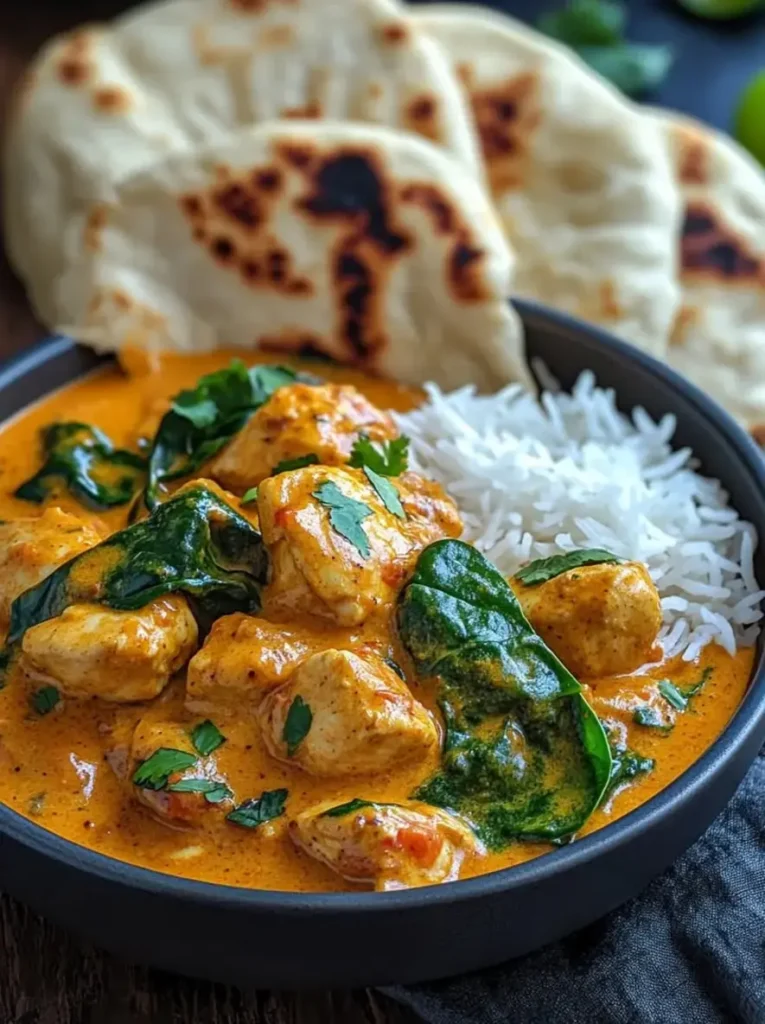
Creamy Indian-Inspired Chicken Curry with Fresh Spinach, Fragrant Spices, Garlic Naan, and Fluffy Rice – A One-Pot Comfort Meal That Feels Like a Warm Hug
I still remember the first time I tasted a truly great Indian-inspired curry — not in a restaurant, but in my tiny Paris apartment during culinary school. A classmate from Mumbai handed me a spoonful of her grandmother’s chicken curry, fragrant with cumin and coriander, and I was instantly transported. That moment stayed with me through my years training in French sauce work, and later, when I moved to New York City, I started tinkering with my own creamy Indian chicken curry recipe — one that marries those bold, aromatic spices with the silky richness of a French-trained cream sauce, and finishes with a generous handful of fresh spinach for color, nutrition, and that gorgeous pop of green. This chicken curry with spinach has become one of my most-requested weeknight dinners, and today I’m sharing every secret I’ve learned along the way.
Picture this: tender, bite-sized pieces of chicken thigh that have been gently simmered in a sauce built from crushed tomatoes, chicken broth, and heavy cream — but not before the spices have had their moment to bloom in hot oil, releasing an intoxicating aroma that fills your entire kitchen. The cumin hits first, earthy and warm, followed by coriander’s citrusy brightness, turmeric’s golden hue, and garam masala’s complex, almost floral finish. Then comes the spinach — three whole cups of it — wilting into the sauce in just minutes, turning the curry into something that feels both indulgent and nourishing all at once. Served over a mound of fluffy basmati rice with warm garlic naan on the side for scooping, this is the kind of meal that makes a Tuesday night feel like a special occasion.
What sets my version of this Indian chicken curry with coconut milk (yes, you can swap the heavy cream for coconut milk — and I’ll show you exactly how to do it without the sauce breaking!) apart from others is the technique I borrowed from my French training: patience. We’re going to let those onions soften until they’re almost melting, bloom the spices just until they’re fragrant but never burnt, and simmer the sauce for a full ten minutes before the chicken even goes in. That step alone — letting the tomato base reduce and concentrate — is what transforms a good curry into a great one. I’m also going to share my foolproof trick for keeping the garlic naan from getting soggy (a question I get asked all the time), plus the one mistake even experienced cooks make when adding spinach to hot sauce. Stick with me, and you’ll nail this easy chicken curry on your very first try.
Why This Creamy Indian Chicken Curry Recipe Is the Best
The Flavor Secret: Growing up in Morocco, I learned early that spices aren’t just ingredients — they’re the soul of a dish. My mother would toast whole cumin and coriander seeds in a dry pan before grinding them, and that fragrance is etched into my memory. In this creamy Indian chicken curry recipe, I lean on that same principle: we bloom ground spices in hot oil for just thirty seconds before adding any liquid. That brief sizzle unlocks essential oils in the cumin, coriander, turmeric, and garam masala, creating a depth of flavor that you simply cannot achieve by dumping spices into a simmering sauce. It’s a tiny step with an enormous payoff — and it’s the difference between a curry that tastes “nice” and one that makes people close their eyes and sigh.
Perfected Texture: Here’s where my Paris training really shines. A great curry sauce should coat the back of a spoon — not too thin, not gluey. To achieve that velvety consistency, I use a combination of crushed tomatoes (which break down into the sauce) and heavy cream, added at the very end so it doesn’t curdle under high heat. The chicken thighs — and yes, thighs are non-negotiable here for their superior moisture and flavor — get cut into uniform bite-sized pieces so they cook evenly and absorb maximum sauce. And the spinach? We add it off the heat, letting the residual warmth gently wilt the leaves so they retain their vibrant green color and tender texture. No one wants grey, mushy spinach in their beautiful curry.
Foolproof & Fast: I know what it’s like to come home after a long day in the city — whether you’re commuting on the subway or cycling through Brooklyn — and still want to put a home-cooked meal on the table. This easy chicken curry comes together in about an hour, and most of that time is hands-off simmering while you put your feet up, make the rice, or warm the naan. It’s a true one-pot meal (minus the rice), which means less cleanup and more time to actually enjoy your evening. I’ve tested this recipe over a dozen times, adjusting the spice levels, the cream-to-tomato ratio, and the timing, so you don’t have to guess. Whether you’re a curry novice or a seasoned home cook, you’ll find this recipe reliable, adaptable, and deeply satisfying.
Creamy Indian Chicken Curry Recipe Ingredients
Every time I gather these ingredients, I’m reminded of walking through the Union Square Greenmarket on a crisp autumn morning — the piles of fresh spinach catching the light, the scent of ginger and garlic from a nearby vendor. When I can, I grab my onions and ginger from the farmers market; the difference in freshness is remarkable. But don’t worry — everything on this list is readily available at any well-stocked US grocery store, from Whole Foods to Trader Joe’s to your neighborhood supermarket. The key is choosing quality spices (more on that below) and fresh, vibrant spinach.
Ingredients List
- For the Curry:
- 1 tablespoon vegetable oil
- 1 large onion, finely chopped
- 4 cloves garlic, minced
- 1 tablespoon fresh ginger, grated
- 2 teaspoons ground cumin
- 2 teaspoons ground coriander
- 1 teaspoon turmeric
- 1 teaspoon garam masala
- 1/2 teaspoon cayenne pepper (optional)
- 1 (14 oz) can crushed tomatoes
- 1 cup chicken broth
- 1 cup heavy cream
- 1 1/2 pounds boneless, skinless chicken thighs, cut into bite-sized pieces
- 3 cups fresh spinach, roughly chopped
- Salt and pepper to taste
- For Serving:
- Cooked basmati rice
- Garlic naan bread, warmed
Ingredient Spotlight
Chicken Thighs: I choose boneless, skinless chicken thighs for this recipe because they have a higher fat content than breasts, which means they stay juicy and tender during the simmering process. Look for thighs that are pink and firm with no off-odor. At the grocery store, you’ll typically find them in the poultry section, often sold in packs of 1 to 1.5 pounds. If you only have chicken breasts, you can absolutely substitute them — just reduce the simmering time by about 5 minutes and keep a close eye on the internal temperature (165°F is your target) to prevent dryness. The texture will be slightly firmer, but the sauce will still be delicious.
Fresh Spinach: Three cups may sound like a lot, but spinach wilts down dramatically — what starts as a towering mountain of leaves becomes just a few tender ribbons swirled through the sauce. I prefer flat-leaf spinach (sometimes labeled “baby spinach”) for its tender texture and mild flavor. When shopping, look for crisp, bright green leaves with no sliminess or yellowing. Pre-washed bags are a huge time-saver and work perfectly here. If you must use frozen spinach, thaw it completely and squeeze out every last drop of water — excess moisture can thin out your sauce and make it watery. The flavor will be slightly earthier, but still good.
Garam Masala: This is the backbone of the curry’s warm, complex aroma. Garam masala is a blend of spices — typically cinnamon, cardamom, cloves, cumin, and black pepper — that’s added toward the end of cooking to preserve its fragrance. You can find it in the spice aisle of most US supermarkets (McCormick makes a widely available version), but if you have access to an Indian grocery store or a specialty spice shop, the freshness and potency will be noticeably better. A good garam masala should smell sweet and heady, not dusty. Substitution: If you’re in a pinch, mix equal parts ground cumin and ground coriander with a pinch of cinnamon — it won’t be identical, but it’ll get you close.
Heavy Cream: This is what gives the curry its signature velvety richness. Heavy cream (also labeled “heavy whipping cream”) has a fat content of at least 36%, which means it’s less likely to curdle when added to hot sauce. Pour it in slowly and stir gently — I like to take the pot off the heat for just a minute before adding the cream, which gives the sauce a moment to cool slightly and ensures a smooth, silky finish. For a dairy-free version, full-fat canned coconut milk is your best bet (see the Variations section for my exact method).
| Original Ingredient | Best Substitution | Flavor / Texture Impact |
|---|---|---|
| Chicken thighs | Chicken breasts or tofu | Slightly firmer texture; reduce cook time by 5 minutes |
| Fresh spinach | Frozen spinach (thawed, squeezed dry) | Earthier flavor; Ensure all water is removed to avoid thinning sauce |
| Heavy cream | Full-fat canned coconut milk | Lighter, slightly sweet, dairy-free; sauce may be thinner |
| Garam masala | Equal parts cumin + coriander + pinch cinnamon | Similar warmth but less complex; still delicious |
| Crushed tomatoes | Diced tomatoes (blended slightly) | Chunkier texture; blend for smoothness if desired |
How to Make Creamy Indian-Inspired Chicken Curry — Step-by-Step
Alright, my friend — let’s cook this beautiful curry together. I promise, once you smell those spices blooming in the oil, you’ll understand why I make this dish at least twice a month. Here’s exactly how to do it, with all the little tips I’ve picked up along the way.
Step 1: Sweat the Onion
In a large pot or Dutch oven, heat the vegetable oil over medium heat. Add the finely chopped onion and cook, stirring occasionally, until softened and translucent — about 5 minutes. You’re not looking for browning here; we want the onion to release its moisture and turn sweet and tender. If your onion starts to color too quickly, lower the heat slightly. This gentle start builds the foundational sweetness of the curry.
💡 Lalybeth’s Pro Tip: Take an extra minute to chop your onion as finely as you can — almost a mince. This helps it melt into the sauce as it cooks, creating a smoother final texture. I learned this trick in Paris while making sauce bases for French stews, and it works beautifully in curries too.
Step 2: Add the Garlic and Ginger
Add the minced garlic and grated ginger to the pot and cook for 1 minute, stirring constantly, until incredibly fragrant. That heady scent of garlic and ginger hitting hot oil is one of my favorite kitchen moments — it’s the signal that your flavor base is building. Be careful not to let the garlic burn; burned garlic turns bitter and will ruin the entire sauce. Keep the heat at medium and keep things moving.
⚠️ Common Mistake to Avoid: Using pre-minced jarred garlic or ginger paste from a tube. I get it — they’re convenient. But they often contain preservatives and lack the bright, pungent freshness of freshly minced garlic and grated ginger. For a recipe where aromatics are this important, fresh really does make a difference. Grate your ginger on a microplane (no need to peel it!) and mince your garlic just before it hits the pan.
Step 3: Bloom the Spices
Stir in the cumin, coriander, turmeric, garam masala, and cayenne (if using). Cook for exactly 30 seconds, stirring constantly. This step — called “blooming” — is the single most important technique in this entire recipe. The hot oil draws out the essential oils in the spices, intensifying their flavors dramatically. You’ll know it’s working when your kitchen fills with an incredible, warm, complex aroma. Don’t walk away during this step — spices can go from fragrant to burnt in seconds.
💡 Lalybeth’s Pro Tip: If your spices have been sitting in your pantry for more than six months, give them a sniff before using. They should smell vibrant and aromatic, not dusty or faint. Stale spices are the number one reason home-cooked curries taste flat. I buy mine in small quantities from a spice shop in the East Village, but even replacing your supermarket jars once a year makes a huge difference.
Step 4: Build the Sauce Base
Pour in the crushed tomatoes and chicken broth. Stir well, scraping up any spices that may have stuck to the bottom of the pot. Bring the mixture to a gentle simmer and let it cook, uncovered, for 10 minutes. This is where the magic happens — the tomatoes break down, the broth reduces slightly, and all those flavors marry together into a cohesive sauce. Stir occasionally to prevent sticking. The sauce should darken slightly and thicken just a bit.
⚠️ Common Mistake to Avoid: Rushing this simmering step. I know you’re hungry, but those 10 minutes are crucial for developing depth of flavor. If you add the chicken too soon, the sauce will taste thin and one-dimensional. Set a timer, pour yourself a glass of wine, and let the sauce do its thing.
Step 5: Cook the Chicken
Add the bite-sized chicken thigh pieces to the simmering sauce. Give everything a good stir to coat the chicken evenly. Cover the pot with a lid and simmer for 15 to 20 minutes, until the chicken is cooked through and tender. Check for doneness by cutting into the largest piece — it should be completely white with no pink in the center. The internal temperature should reach 165°F. Because we’re using thighs, even if you go a few minutes over, the chicken will stay juicy.
💡 Lalybeth’s Pro Tip: Cut your chicken pieces as uniformly as you can — about 1-inch chunks. Uniform pieces cook at the same rate, so you won’t end up with some pieces perfectly done and others over- or under-cooked. I use kitchen shears for this; they’re faster and less fussy than a knife and cutting board.
Step 6: Finish with Cream and Spinach
Remove the pot from the heat (or slide it off the burner). Stir in the heavy cream slowly, then add the fresh spinach. The residual heat will gently wilt the spinach in just 2 to 3 minutes — you’ll see the leaves soften and turn a vibrant dark green. Stir gently to distribute everything evenly. Taking the pot off the heat before adding the cream is my secret for preventing curdling — the sauce is still plenty hot enough to wilt the spinach and warm the cream through, but not so hot that the dairy separates.
⚠️ Common Mistake to Avoid: Adding the spinach all at once and then walking away. Spinach wilts fast — in about 2 minutes — and if you overcook it, it turns a dull olive green and develops a slightly slimy texture. Stand by the pot, stir gently, and as soon as the leaves have collapsed, move on to seasoning. Your curry will look bright, fresh, and appetizing.
Step 7: Season and Serve
Season the finished curry with salt and pepper to taste. I usually start with about 1/2 teaspoon of salt and a few grinds of black pepper, then adjust from there. Remember that the salt level should balance the richness of the cream and the acidity of the tomatoes — so don’t be shy. Serve the curry immediately over fluffy basmati rice with warm garlic naan on the side. Spoon that gorgeous sauce over everything and dig in.
💡 Lalybeth’s Pro Tip: Taste your curry just before serving and ask yourself: does it need a little something? A tiny squeeze of fresh lemon juice can brighten the entire dish, cutting through the richness of the cream. Alternatively, a pinch of sugar (just a pinch!) can round out any acidity from the tomatoes. This final adjustment — what chefs call “correcting the seasoning” — is what elevates home cooking to restaurant quality.
| Step | Action | Duration | Key Visual Cue |
|---|---|---|---|
| 1 | Sweat the onion | 5 minutes | Onion turns translucent and soft |
| 2 | Add garlic & ginger | 1 minute | Intensely fragrant, no browning |
| 3 | Bloom the spices | 30 seconds | Aroma intensifies dramatically |
| 4 | Build the sauce base | 10 minutes | Sauce darkens and thickens slightly |
| 5 | Cook the chicken | 15–20 minutes | Chicken white throughout, 165°F internal |
| 6 | Finish with cream & spinach | 2–3 minutes | Spinach wilts, sauce turns creamy and green-flecked |
| 7 | Season and serve | 1 minute | Balanced flavor, vibrant presentation |
Serving & Presentation
This curry demands to be served family-style — a big, beautiful pot set right in the middle of the table, surrounded by bowls of steaming basmati rice and a stack of warm, garlicky naan bread. When I host dinner parties in my NYC apartment, this is the dish that gets everyone leaning in, reaching for seconds before they’ve finished their first plate. I like to spoon the rice into wide, shallow bowls first, then ladle the curry generously over one side so the sauce pools around the rice without drowning it. A final flourish of fresh cilantro leaves — if you’re a cilantro person — adds a bright, herbal note that cuts through the richness beautifully.
The garlic naan deserves a moment of attention too. When I was training in Paris, we learned that bread service is just as important as the main course — it sets the tone for the meal. I warm my naan in a dry skillet over medium-high heat for about 30 seconds per side, just until it’s soft and pliable with a few charred spots. Then I wrap it in a clean kitchen towel and bring it to the table still warm. The towel traps steam, keeping the naan soft rather than drying it out. For an extra touch, brush the warm naan with a little melted butter and a sprinkle of flaky sea salt — it’s indulgent, yes, but so worth it.
For a complete meal that feels restaurant-worthy, I often add a simple cucumber raita on the side — just grated cucumber stirred into plain yogurt with a pinch of salt and a sprinkle of cumin. The cool, tangy raita is the perfect counterpoint to the warm, spiced curry. If I’m feeling extra ambitious, a quick pickled onion (thinly sliced red onion tossed with lime juice and salt) adds a zippy, acidic crunch that wakes up every bite. These little extras take just minutes to throw together but make the whole meal feel intentional and celebratory.
| Pairing Type | Suggestions | Why It Works |
|---|---|---|
| Side Dish | Cucumber raita, pickled red onions, roasted cauliflower | Cool, tangy, or crunchy elements contrast the rich, creamy curry |
| Sauce / Dip | Mango chutney, cilantro-mint chutney, plain yogurt | Sweet or herbaceous notes balance the savory spices |
| Beverage | Mango lassi, chilled lager beer, crisp Sauvignon Blanc | A little sweetness or acidity cuts through the creaminess |
| Garnish | Fresh cilantro, toasted slivered almonds, a drizzle of cream | Adds visual appeal and a final layer of texture and freshness |
Make-Ahead, Storage & Reheating
One of the things I love most about this curry is how beautifully it keeps. In fact, like most spiced dishes, the flavors continue to deepen overnight — so if you can make it a day ahead, you’ll be rewarded with an even more complex, mellow curry the next day. In my busy NYC life, I often make a double batch on Sunday afternoon, portion it out for the week, and feel like a genius every time I pull a container from the fridge. Here’s exactly how to store, freeze, and reheat it so it tastes just as good as day one.
| Method | Container | Duration | Reheating Tip |
|---|---|---|---|
| Refrigerator | Airtight glass container | Up to 3 days | Reheat gently in a saucepan over medium-low, stirring often. Add a splash of broth or water if the sauce has thickened |
| Freezer | Freezer-safe container or heavy-duty zip-top bag | Up to 2 months | Thaw overnight in the fridge, then reheat slowly on the stovetop. Cream-based sauces can separate when frozen — stir vigorously while reheating |
| Make-Ahead | Refrigerate in the cooking pot with a lid | Up to 2 days in advance | Hold off on adding the spinach until you reheat the curry — add fresh spinach just before serving for the brightest color and best texture |
Here’s my personal meal-prep strategy: I make the curry all the way through step 5 (cooking the chicken), let it cool, and refrigerate it. Then, on the night I’m serving it, I bring it back to a gentle simmer on the stove, add the cream and fresh spinach, season, and serve. This way, the spinach stays vibrant green and the cream tastes fresh and luscious. If you’ve already added the spinach and cream before storing, don’t worry — it’ll still taste great, but the spinach may darken slightly. Just reheat it gently and give it a good stir.
One important note: when reheating, always use low to medium-low heat. High heat can cause the cream to separate, resulting in an oily-looking sauce. If that happens, don’t panic — just remove the pot from the heat, add a tablespoon of cold water or broth, and whisk vigorously. The sauce should come back together. It won’t be quite as silky as day one, but it’ll still be delicious. And never, ever reheat this curry in the microwave if you can avoid it — the uneven heat can make the chicken rubbery and the sauce grainy. A few minutes on the stovetop is well worth the minimal extra effort.
Variations & Easy Swaps
| Variation | Key Change | Best For | Difficulty Impact |
|---|---|---|---|
| Dairy-Free / Vegan | Swap cream for coconut milk; use tofu or chickpeas | Dairy-free, vegan diets | No change |
| Spicy Kick | Add extra cayenne, fresh slit green chili, or a spoonful of chili paste | Heat lovers | No change |
| Extra Veggie-Packed | Add diced sweet potato, cauliflower florets, or peas along with the chicken | Adding more vegetables, stretching servings | Slightly longer cook time for root vegetables |
Dairy-Free / Vegan Indian-Inspired Curry with Coconut Milk
This is probably the variation I make most often, and honestly, it’s just as luxurious as the cream version — just in a different way. Swap the heavy cream for one full can of full-fat coconut milk (the kind that’s solid at room temperature, not the light version). Shake the can well, then pour it in at the same stage you’d add the cream. For a vegan version, replace the chicken with extra-firm tofu (pressed and cubed) or two cans of drained chickpeas, and use vegetable broth instead of chicken broth. The coconut milk adds a subtle sweetness that works beautifully with the spices — it reminds me a little of certain Moroccan tagines my mother used to make, where dried fruits and warm spices mingled in a single pot. Reduce the simmering time for tofu to about 10 minutes so it doesn’t break apart. The sauce may appear slightly thinner than the cream version at first, but it thickens as it sits.
Spicy Kick — Turn Up the Heat
If you’re like me and believe that a good curry should make your lips tingle just a little, this variation is for you. In addition to the optional cayenne in the base recipe, try adding one or two fresh green chilies (like serrano or Thai bird’s eye) — slit them lengthwise and toss them into the sauce along with the chicken. They’ll infuse the curry with a slow-building heat that’s much more nuanced than just adding more cayenne. You can also finish the dish with a drizzle of chili oil or a spoonful of your favorite hot chili paste stirred in at the end. During my time in Paris, a chef once taught me that heat should enhance, not overpower — so start conservatively and taste as you go. You can always add more heat, but you can’t take it out.
Extra Veggie-Packed Curry
When the Union Square Greenmarket is bursting with produce, I love turning this curry into a vegetable showcase. Add 1 cup of diced sweet potato or butternut squash along with the chicken — they’ll need the full 20 minutes to become tender. Cauliflower florets also work beautifully, soaking up the sauce like little sponges. A handful of frozen peas tossed in during the last 2 minutes adds a pop of sweetness and color that reminds me of the vegetable couscous dishes of my childhood in Morocco. This variation stretches the recipe to serve 6 easily, and makes the meal feel even more abundant. Just note that if you add a lot of vegetables, you may want to increase the broth by a splash or two to keep the sauce from becoming too thick.
How can I make this creamy Indian-inspired chicken curry dairy-free or vegan?
Making this curry dairy-free is wonderfully simple and yields a dish that’s just as satisfying as the original. Swap the heavy cream for one full can of full-fat coconut milk — I recommend brands like Thai Kitchen or Native Forest that are thick and creamy at room temperature, as light coconut milk can make the sauce too thin. For a fully vegan version, replace the chicken with extra-firm tofu (pressed and cut into bite-sized cubes) or two cans of drained chickpeas, and use vegetable broth instead of chicken broth. Reduce the simmering time for tofu to about 10 minutes so it stays tender. The coconut milk adds a subtle natural sweetness that complements the warm spices beautifully, and the sauce will still be rich and velvety. I’ve served this vegan version at many NYC dinner parties, and even my most carnivorous friends have gone back for seconds without realizing they were eating a plant-based meal.
Can I substitute fresh spinach with frozen spinach in this curry recipe?
You can absolutely use frozen spinach in a pinch, and I’ve done it many times during the depths of winter when fresh spinach at the market looks sad and wilted. The key is preparation: thaw the frozen spinach completely — either overnight in the refrigerator or in the microwave — then place it in a clean kitchen towel or several layers of paper towels and squeeze firmly to remove as much water as possible. Excess moisture is the enemy here; it will water down your carefully built sauce and dilute the spices. One 10-ounce package of frozen spinach, once thawed and squeezed, yields roughly the equivalent of 2 to 2½ cups of fresh spinach, so you may want to use a little extra. The flavor will be slightly earthier and more concentrated than fresh spinach, and the texture will be a bit softer, but it’ll still swirl beautifully into the curry. Just be sure to add it at the same stage and cook it just until heated through.
What is the best cut of chicken to use for a creamy Indian curry?
Boneless, skinless chicken thighs are, in my opinion, the absolute best choice for this creamy Indian chicken curry recipe — and I say that as someone who spent years in French kitchens learning about meat cookery. Thighs have more fat and connective tissue than breasts, which means they stay juicy, tender, and flavorful even after 15 to 20 minutes of simmering. They’re also more forgiving: if you get distracted and let them cook a few minutes too long, they won’t dry out the way breasts can. If you prefer white meat or that’s what you have on hand, chicken breasts will certainly work — just cut them into slightly larger chunks (about 1½ inches) and reduce the covered simmering time to 12 to 15 minutes. Check for doneness with an instant-read thermometer (165°F is your target) and pull them off the heat as soon as they’re cooked through. The texture will be firmer and the flavor slightly milder, but the sauce is flavorful enough to carry the dish either way.
How do you prevent the garlic naan from getting soggy when serving with the curry?
This is such a great question, and it’s one I get asked constantly. The secret to keeping garlic naan soft and pliable without letting it turn into a soggy mess involves two things: proper warming technique and strategic serving. First, warm your naan in a dry skillet over medium-high heat for about 30 to 45 seconds per side — this creates a slightly crisp exterior with a few charred spots while keeping the inside soft. Never microwave naan, as the steam will make it rubbery and damp. Second, serve the naan on a separate plate or in a bread basket lined with a cloth napkin, NOT placed directly under or on top of the curry. The cloth absorbs any residual steam while keeping the bread warm. If you’re plating for guests, place the naan to the side of the bowl, slightly overlapping the edge if you like, but never fully submerged in the sauce until the moment you’re ready to tear and scoop. A final tip: brushing the warm naan with a little melted butter or ghee creates a slight barrier that helps repel moisture for a few extra minutes. In my NYC kitchen, I always warm the naan at the very last moment — just as I’m ladling the curry into bowls — so it arrives at the table hot, soft, and perfectly crisp at the edges.
Can I make this creamy chicken curry in an Instant Pot or slow cooker?
Yes, this curry adapts beautifully to both the Instant Pot and slow cooker, and I’ve tested it both ways in my own kitchen. For the Instant Pot: Use the sauté function to sweat the onion, bloom the spices, and simmer the tomato-broth base (steps 1 through 4). Then add the chicken, seal the lid, and pressure cook on high for 8 minutes with a natural release for 5 minutes before manually releasing any remaining pressure. Stir in the cream and spinach after opening the lid, while the curry is still piping hot. For the slow cooker: Complete steps 1 through 4 on the stovetop (don’t skip blooming the spices — it’s essential), then transfer everything to the slow cooker along with the chicken. Cook on low for 4 to 6 hours or on high for 2 to 3 hours. Add the cream and spinach right before serving. The slow cooker version yields incredibly tender, almost falling-apart chicken, but the sauce may be slightly thinner — you can thicken it by simmering uncovered for 10 minutes after adding the cream.
What can I use instead of heavy cream to make a lighter chicken curry?
If you’re looking to lighten up this curry without sacrificing all its creamy comfort, you have several excellent options. Full-fat canned coconut milk is my top recommendation for a dairy-free alternative — it’s still rich but has a different nutritional profile (and no lactose). For a lower-calorie but still creamy option, use half-and-half instead of heavy cream; the sauce will be slightly thinner but still pleasantly velvety. Plain Greek yogurt is another favorite of mine — but here’s the trick: remove the pot from the heat and let it cool for 2 to 3 minutes before stirring in the yogurt, and do so gently. If yogurt is added to boiling liquid, it will curdle immediately. You’ll get a tangy, lighter sauce that’s absolutely delicious, though not quite as silky as the cream version. I’ve also had success with cashew cream (blend 1 cup of soaked raw cashews with ¾ cup of water until completely smooth), which adds a nutty richness that’s surprisingly close to dairy cream. Each of these swaps changes the character of the dish slightly, but all of them produce a satisfying, comforting curry.
Is this curry spicy? How can I adjust the heat level for my family?
As written, with the optional ½ teaspoon of cayenne pepper included, this curry delivers a gentle, warming heat that most people would describe as mild to medium — the kind that softly tingles on your tongue without building into a burn. The cream and spinach also help mellow the spices considerably. If you’re cooking for young children or anyone who’s spice-averse, simply omit the cayenne entirely — the curry will still be deeply flavorful from the cumin, coriander, turmeric, and garam masala, just without any perceptible heat. For those who love fire, you can double the cayenne, add a slit fresh serrano or Thai chili along with the chicken, or finish the dish with a drizzle of chili oil or a spoonful of sambal oelek. I always recommend starting conservative and tasting as you go, because it’s much easier to add heat than to tame it. One pro tip from my Paris training: a small spoonful of sugar or a splash of coconut milk can help balance a curry that’s become too spicy — it won’t remove the heat entirely, but it will round out the edges.
Can I use chicken breast instead of chicken thighs in this Indian chicken curry?
You can absolutely use chicken breast, and I’ve done it when that’s all I had in the fridge. The key is to treat breasts more gently than thighs because they’re leaner and more prone to drying out. Cut the breasts into slightly larger chunks — about 1½ to 2 inches — so they don’t overcook as quickly. Reduce the covered simmering time to 12 to 15 minutes, and start checking for doneness at the 12-minute mark. The chicken is ready when it reaches 165°F on an instant-read thermometer and is opaque white throughout with no pink. If you want to go the extra mile, you can brine the chicken breasts in a solution of 4 cups water, ¼ cup salt, and 2 tablespoons sugar for 20 to 30 minutes before cooking — a technique I picked up in culinary school that helps lean cuts retain moisture. Pat the chicken dry thoroughly before adding it to the curry so you don’t water down the sauce. The final dish will have a slightly firmer texture than the thigh version, but with this rich, spiced sauce, it will still be a satisfying, delicious meal.
Share Your Version!
I truly believe that recipes are meant to be shared, adapted, and made your own. Every time I cook this curry, it comes out a little differently — maybe the spinach is extra tender from the farmers market, or I’m feeling bold with the cayenne, or I’ve swapped in coconut milk because a dairy-free friend is coming to dinner. That’s the beauty of home cooking: it’s alive, personal, and always evolving. I would genuinely love to see what you create. Did you add a surprise ingredient? Did your kids gobble it up? Did you try the vegan version and fall in love with it? Whatever your story is, I want to hear it.
If you make this creamy Indian chicken curry recipe, please drop a star rating and a comment below — it helps other readers find the recipe and lets me know how it turned out for you. Snap a photo of your beautiful creation and tag me on Instagram or Pinterest @cookingwithlalyta — I share my favorite reader photos in my stories, and seeing your versions genuinely makes my day. And here’s a question I’d love you to answer in the comments: What’s one spice or ingredient you were nervous to cook with that’s now a staple in your kitchen? For me, it was garam masala — that first jar sat unopened in my Paris apartment for weeks before I finally dove in. Now I can’t imagine my kitchen without it. I can’t wait to hear your stories. From my NYC kitchen to yours — I hope this recipe brings as much warmth to your table as it does to mine. — Lalybeth 🧡
Love This Recipe? Save It to Pinterest!
If you enjoyed this Creamy Indian-Inspired Chicken Curry with Fresh Spinach, Fragrant Spices, Garlic Naan, and Fluffy Rice recipe, don’t let it get lost in your browser tabs! 😄 Pin it now so you can find it again anytime — and explore hundreds more tried-and-tested recipes waiting for you on my Pinterest boards.
👉 Follow Lalybeth on Pinterest @cookingwithlalyta
📌 Pin this recipe · 🔁 Re-pin your favorites · 💬 Tag me when you make it — I love seeing your creations!

Creamy Indian-Inspired Chicken Curry with Fresh Spinach, Fragrant Spices, Garlic Naan, and Fluffy Rice
- Total Time: 1 hour
- Yield: 4 1x
Description
A rich and creamy curry made with tender chicken, fresh spinach, and a blend of fragrant spices. Served with garlic naan and fluffy rice, this dish is a comforting and flavorful weeknight meal.
Ingredients
- For the Curry:
- 1 tablespoon vegetable oil
- 1 large onion, finely chopped
- 4 cloves garlic, minced
- 1 tablespoon fresh ginger, grated
- 2 teaspoons ground cumin
- 2 teaspoons ground coriander
- 1 teaspoon turmeric
- 1 teaspoon garam masala
- 1/2 teaspoon cayenne pepper (optional)
- 1 (14 oz) can crushed tomatoes
- 1 cup chicken broth
- 1 cup heavy cream
- 1 1/2 pounds boneless, skinless chicken thighs, cut into bite-sized pieces
- 3 cups fresh spinach, roughly chopped
- Salt and pepper to taste
- For Serving:
- Cooked basmati rice
- Garlic naan bread, warmed
Instructions
- 1. In a large pot or Dutch oven, heat the vegetable oil over medium heat. Add the onion and cook until softened, about 5 minutes.
- 2. Add the garlic and ginger, and cook for 1 minute until fragrant.
- 3. Stir in the cumin, coriander, turmeric, garam masala, and cayenne (if using). Cook for 30 seconds, stirring constantly.
- 4. Pour in the crushed tomatoes and chicken broth. Bring to a simmer and cook for 10 minutes, allowing the flavors to meld.
- 5. Add the chicken pieces to the sauce. Cover and simmer for 15-20 minutes, until the chicken is cooked through.
- 6. Stir in the heavy cream and fresh spinach. Cook for 2-3 minutes, until the spinach wilts.
- 7. Season with salt and pepper to taste.
- 8. Serve the curry over fluffy basmati rice with warm garlic naan on the side.
Notes
For a lighter version, substitute heavy cream with coconut milk. The curry can be made ahead and refrigerated for up to 3 days. Adjust cayenne to your preferred spice level.
- Prep Time: 20 minutes
- Cook Time: 40 minutes
- Method: Main
- Cuisine: Indian-inspired
Nutrition
- Calories: 550
- Sugar: 5g
- Fat: 30g
- Carbohydrates: 45g
- Protein: 35g

Tried This Recipe? Leave a Comment!
Did you make this recipe? I’d love to hear how it turned out! Please leave a comment and a rating below. Your feedback helps other home cooks and supports cookingwithlalyta.com!
For more delicious inspiration, follow me on Pinterest!