Table of Contents
Sweet Potato & Beet Stacks with Pesto, Burrata & Walnuts — The Foolproof Stacking Technique
Growing up in my Moroccan mother’s kitchen, I learned that the most beautiful dishes often come from the simplest techniques. These Sweet Potato & Beet Stacks with Pesto, Burrata & Walnuts take me right back to that principle—vibrant, earthy rounds stacked high, kissed with the bright green of basil pesto and finished with a creamy, decadent tear of burrata. It’s the kind of appetizer that stops everyone mid-sentence at a dinner party, yet requires no fancy equipment or impossible-to-find ingredients. In fact, the first time I ever served these beautiful stacks was at a tiny NYC rooftop gathering, using beets and sweet potatoes I’d picked up from the Union Square Greenmarket. The secret to their stunning presentation? A foolproof roasting method that ensures every slice stays firm enough to stack without falling apart—a technique I perfected in my Paris training days when I was tasked with making vegetable terrines that could stand up with confidence.
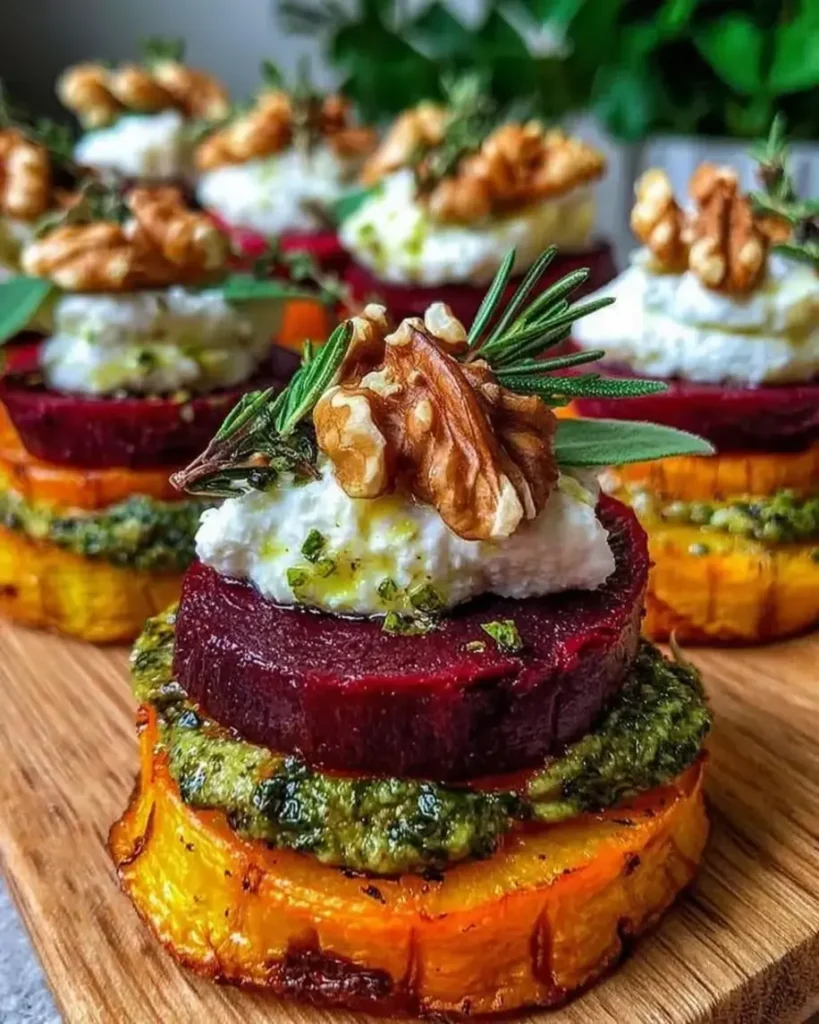
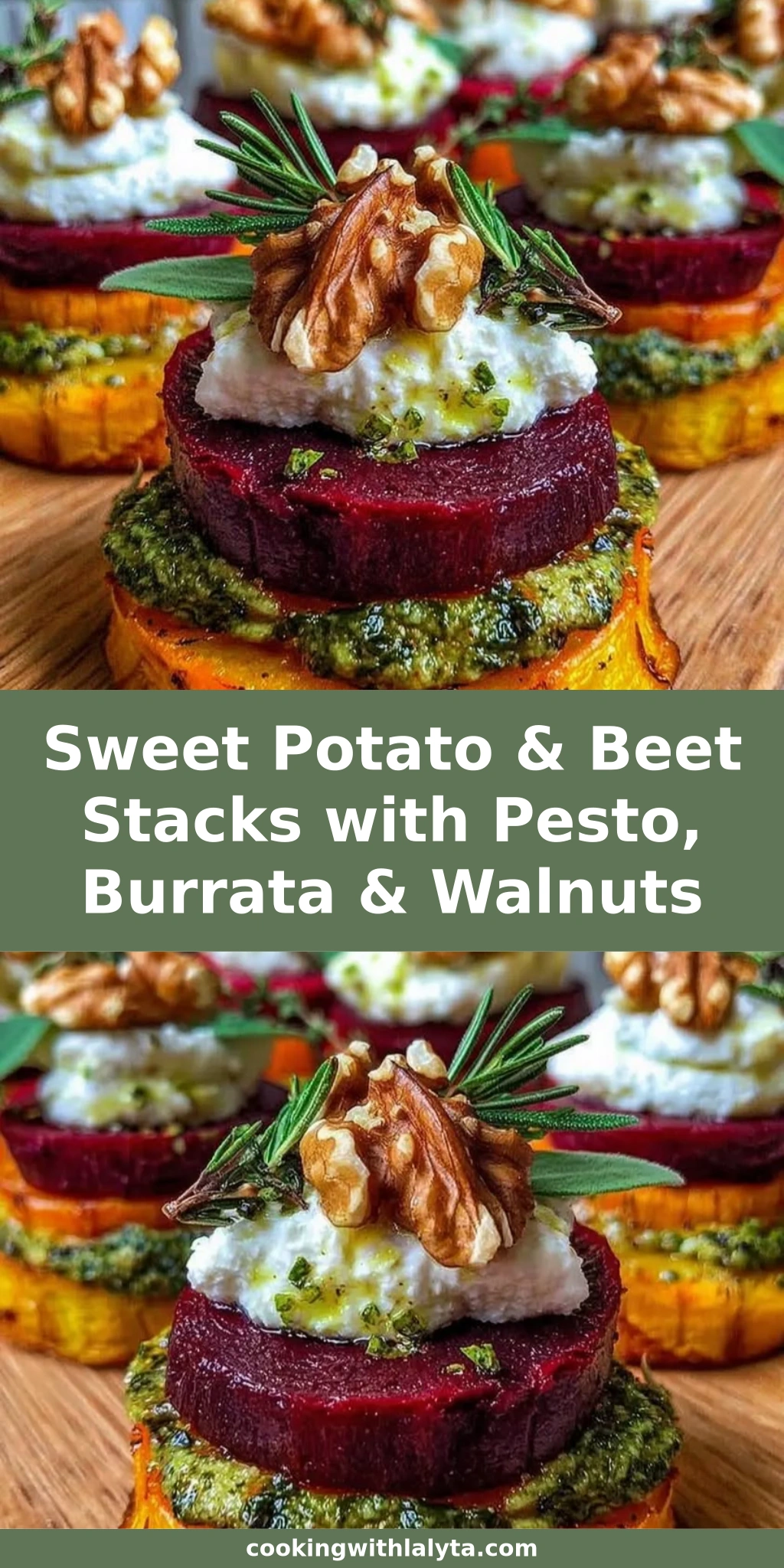
Imagine cutting into a tower where the natural sweetness of caramelized sweet potato meets the deep, mineral richness of roasted beetroot. Each layer is punctuated by a smear of garlicky, herbaceous pesto—the kind that wakes up your palate—and then there’s that moment when the knife glides through a cloud of cool, creamy burrata, its stracciatella filling spilling out like liquid silk. The toasted walnuts add a final crunch that echoes the nuttiness of the pesto, while fresh basil leaves bring a pop of color and a whisper of summer. It’s a texture symphony: soft yet substantial, creamy yet crisp, and every bite balances on that edge between rustic comfort and elegant refinement. From my French culinary school days, I remember our chef shouting “la cuisson, c’est tout!”—the cooking is everything—and here the precise roasting time is what transforms these humble root vegetables into stackable perfection.
I’ve tested this recipe dozens of times, from lazy Sunday lunches in my sunlit Brooklyn kitchen to a trial run for a friend’s baby shower where I assembled thirty individual stacks without a single tower tumble. My version differs from others you might find online because I use a specific oven temperature and flip timing that prevents beet bleeding and keeps the sweet potato from turning to mush. Along the way, I’ll share my top pro tip for slicing uniform rounds without a mandoline—a trick I learned from a Parisian charcutier—and the most common mistake home cooks make when roasting beets for stacking (hint: it’s all about the olive oil quantity and how you space them on the sheet pan). By the end, you’ll have a restaurant-worthy vegetarian appetizer that’s as foolproof as it is breathtaking.
Why This Sweet Potato & Beet Stacks Recipe Is the Best
The Flavor Secret — My approach leans on both my North African roots and Parisian training. Instead of relying solely on basil pesto, I often whisk a pinch of Moroccan harissa into the pesto for a subtle, smoky warmth that dances behind the basil’s freshness. This whisper of heat plays beautifully against the creamy burrata and the earthy-sweet vegetables. When you’re making this at home, even a tiny amount of that chili-infused olive oil from your local market can elevate the entire dish from simple to unforgettable. It’s the kind of layered complexity that makes people ask, “What is that magic ingredient?”
Perfected Texture — Through rigorous testing, I discovered that roasting sweet potatoes and beets at exactly 400°F (200°C) for a controlled 20-25 minutes, and flipping them at the 10-minute mark, gives them that ideal “still-firm-yet-tender” quality crucial for stacking. In my Paris training kitchen, we called this “al dente” for vegetables—cooked through but with structural integrity. If you let them go too long, the natural sugars in the sweet potato caramelize into a soft candy, and the beets become too slippery; too short, and you’ll be chewing on raw crunch. This precise timing ensures your stacks sit proud and tall on the plate, never collapsing into a delicious-but-messy heap.
Foolproof & Fast — Even if you’ve never roasted a vegetable in your life, this recipe will make you look like a seasoned chef. The steps are broken down so clearly that you’ll be assembling elegant stacks in under an hour, including oven time. There’s no tricky emulsion to break, no finicky pastry to roll—just slicing, roasting, and layering. I’ve designed it for the busy New York host who wants to serve something that looks like it took all day, but secretly allows them plenty of time to tidy up and pour a glass of rosé before guests arrive. It’s the definition of low-effort, high-impact entertaining.
Sweet Potato Beet Stacks Ingredients
One thing I adore about this recipe is how it springs from my regular ingredient hauls in the city. The sweet potatoes and beets almost always end up in my canvas tote from the weekend farmers market—the beets with their leafy greens still attached, the sweet potatoes in a range of garnet and jewel tones. For the burrata, I slip into Di Palo’s in Little Italy or grab a tub of fresh BelGioioso from my local Whole Foods. The pesto is where you can play: in summer I blend my own from the basil that’s overtaking my fire escape planter, and in winter a high-quality refrigerated store-bought pesto from a brand like Rana or Seggiano works wonders. The walnuts I buy in bulk and toast as needed, because that scent of warming nuts in a dry skillet is my ultimate kitchen comfort signal.
Ingredients List
- 2 medium sweet potatoes (about 1 lb), sliced into 1/4-inch rounds
- 2 medium beets (about 0.75 lb), peeled and sliced into 1/4-inch rounds
- 3 tbsp extra-virgin olive oil, plus more for drizzling
- 1/2 tsp kosher salt, or to taste
- 1/4 tsp freshly ground black pepper
- 1/2 cup pesto (store-bought or homemade)
- 8 oz burrata cheese (about 2 balls)
- 1/2 cup walnut halves, toasted and roughly chopped
- Fresh basil leaves, for garnish
- Flaky sea salt, for finishing
Ingredient Spotlight
Sweet Potatoes: They are the sweet, grounding base of each stack. Look for medium, smooth-skinned jewels with no soft spots—garnet or red-skinned varieties have a higher moisture content that helps them stay tender but not fall apart. Substitution: Butternut squash rounds work wonderfully; they’ll be a touch sweeter and slightly softer, but still hold a stack if you slice them 1/3-inch thick. Expect a more delicate bite with a naturally honeyed flavor.
Beets: Their earthy intensity and vivid magenta hue bring drama to the plate. I always choose firm, heavy beets with smooth skins; golden beets are a stunning alternative that won’t bleed color. Substitution: Chioggia (candy-cane) beets are beautiful and slightly milder, but any roasted root vegetable like carrot or parsnip can step in. Note that carrots will be sweeter and need about 5 minutes less roasting time to stay stackable.
Burrata: This is the creamy crown jewel. The outer mozzarella shell holds the stracciatella treasure inside. When selecting, peek at the liquid in the container—it should be clear and milky. Substitution: Fresh mozzarella (the kind sold in water, not the low-moisture block) is the most direct swap; it’ll taste pure and milky but won’t have that luscious cream center. Ricotta works if you dollop it with a spoon—it will be grainier but still provide a creamy contrast, though the stack will be less dramatic visually. I’d lean toward a high-quality whole-milk ricotta like Calabro, drained of excess liquid.
Pesto: The bright, herbaceous glue that brings everything together. A classic Genovese pesto (basil, pine nuts, Parmesan, garlic, oil) is ideal. Substitution: You can easily use a sun-dried tomato pesto for a punchier, tangier stack, or a kale-walnut pesto for an earthier, dairy-free version. Both will alter the color and intensity, but the flavor logic remains flawless.
| Original Ingredient | Best Substitution | Flavor / Texture Impact |
|---|---|---|
| Sweet Potatoes | Butternut Squash Rounds | Slightly sweeter, more delicate but still stackable; reduce roasting by 5 mins. |
| Beets | Golden Beets or Thick Carrot Rounds | Golden beets are milder, non-bleeding; carrots are sweeter, need 5 mins less roasting. |
| Burrata | Fresh Mozzarella (in water) or Whole-Milk Ricotta | Mozzarella loses the cream center; ricotta offers grainier creaminess, drain first. |
| Basil Pesto | Sun-Dried Tomato Pesto or Kale-Walnut Pesto | Tangy and bold vs. earthy and vegan-friendly; color changes dramatically. |
How to Make Sweet Potato & Beet Stacks — Step-by-Step
Take a deep breath—you’re about to create something truly stunning, and I’ll walk you through every detail. The key is in the mis-en-place: having all your sliced vegetables, pesto, and cheese ready to go makes assembly a joyful, meditative process rather than a scramble.
Step 1: Preheat & Prep
Preheat your oven to 400°F (200°C) with a rack in the middle position. Peel the beets and sweet potatoes. Using a sharp chef’s knife, slice both vegetables into even 1/4-inch rounds. Take your time here—uniformity is the secret to even cooking and stable stacks. If you have a mandoline, feel free to use it, but I prefer the control of a good knife.
💡 Lalybeth’s Pro Tip: To keep rounds uniform without a mandoline, place the vegetable flat on a cutting board and make a tiny horizontal slice on one side to create a stable base. Then slice downward with a controlled rocking motion, using your knuckle as a guide.
Step 2: Roast the Vegetables
In a large bowl, gently toss the sweet potato and beet rounds with 3 tablespoons of olive oil, the salt, and the pepper until every slice is lightly coated. Arrange them in a single layer on two rimmed baking sheets—keep the beets on one side of a sheet or on their own tray to prevent bleeding, though a little magenta kiss on the sweet potatoes can be beautiful. Make sure the slices don’t overlap, or they’ll steam instead of roast. Roast for 20-25 minutes, flipping each round carefully with a thin spatula at the 10-minute mark. You’re looking for edges that are just beginning to turn golden (sweet potatoes) and a concentrated, slightly wrinkled look on the beets. A paring knife should slide through with slight resistance—you want tender, not mushy.
⚠️ Common Mistake to Avoid: Overcrowding the pan is the number one reason vegetables turn soggy. Use two large sheet pans and leave breathing room around each slice. If they’re too close, steam gets trapped and the sugars won’t caramelize, leaving you with limp rounds that turn your beautiful stack into a sliding tower of disappointment.
Step 3: Cool & Assemble the Stacks
Remove the roasted vegetables from the oven and let them cool on the baking sheets for at least 10 minutes—this is crucial. Warm vegetables are more fragile and likely to break during assembly; cooling firms them up just enough. While you wait, place your burrata balls on a paper towel to drain any excess whey, then tear or slice them into bite-sized pieces. To build each stack on a serving platter or individual plates, start with a sweet potato round as the base. Add a beet round, then a small dollop of pesto (about 1/2 teaspoon), and finally a piece of burrata. Repeat the layering once: sweet potato, beet, pesto, burrata. For taller stacks, you can go for three layers, but two layers create the most stable and elegant proportion. Finish the top with a final ribbon of pesto and a tuck of burrata so it looks generous and inviting.
💡 Lalybeth’s Pro Tip: Choose rounds of similar diameters for each stack. When I’m building a party platter, I lay out all the roasted slices and “partner up” the ones that match in size. It creates that polished, restaurant look. If a stack feels wobbly, insert a short bamboo skewer or toothpick through the center to anchor it—just warn your guests!
Step 4: Garnish & Serve
Immediately before carrying your platter to the table, scatter the toasted chopped walnuts over and around the stacks. Tear a few small basil leaves and nestle them into the crevices for a pop of green. Finally, finish with a whisper of flaky sea salt—this isn’t just for show, it amplifies the sweetness of the vegetables and the richness of the burrata. Serve the stacks warm or at room temperature, with a small spoon so guests can scoop up any escaped burrata cream or pesto from the plate.
⚠️ Common Mistake to Avoid: Don’t over-pesto. It’s tempting to ladle on the green goodness, but too much pesto will ooze out the sides and make the stack slippery. Use just enough to coat the surface—you want the flavors to marry, not drown.
| Step | Action | Duration | Key Visual Cue |
|---|---|---|---|
| 1. Prep | Slice sweet potatoes & beets 1/4-inch thick. | 10 mins | Even, clean rounds with no ragged edges. |
| 2. Roast | Toss with oil, salt, pepper; single-layer roast. | 25 mins | Golden edges on sweet potato; beets look concentrated. |
| 3. Cool & Assemble | Cool 10 mins, then layer: sweet potato → beet → pesto → burrata, repeat. | 15 mins | Stacks stand steady with a little pesto peeking out. |
| 4. Garnish | Top with walnuts, basil, flaky salt. | 2 mins | Fresh, vibrant contrast; walnuts look rustic. |
Serving & Presentation
When I bring these stacks to the table, I love placing them on a long, rustic wooden board or a simple white platter that lets the jewel tones sing. A drizzle of extra-virgin olive oil around the stacks adds a glossy finish, and I’ll often scatter a few whole toasted walnuts and tiny basil sprigs across the empty spaces for a “deconstructed” look that feels organic yet refined—a trick I picked up from plating desserts in Paris. If you’re serving these for a holiday gathering, a few pomegranate arils sprinkled over the top bring a tart pop of red that’s both festive and a nod to my Moroccan heritage where we use fruit with savory dishes constantly.
For a light lunch or as part of a mezze spread, I’ll plate individual stacks on small appetizer plates with a side of crusty sourdough bread to mop up any escaped burrata cream and pesto. The slightly tangy bread is a perfect foil. And if you’re in the mood for a full vegetarian dinner, two stacks alongside a simple dressed arugula salad with lemon vinaigrette make a satisfying, beautiful meal. The peppery arugula cuts through the richness beautifully—a pairing I first discovered at a tiny Parisian bistro where they served roasted beet salad with burrata and I thought, “I’m going to build a tower of this.”
| Pairing Type | Suggestions | Why It Works |
|---|---|---|
| Side Dish | Crusty sourdough, arugula salad, warm farro with herbs | Sourdough captures the creams; arugula and farro add peppery or nutty contrast. |
| Sauce / Dip | Extra pesto, balsamic glaze, whipped feta | Pesto echoes the layers; balsamic adds tangy sweetness; feta brings saltiness. |
| Beverage | Crisp Sauvignon Blanc, Prosecco, or a light rosé | Acidity cuts through the cheese; bubbles cleanse the palate between rich bites. |
| Garnish | Pomegranate arils, microgreens, lemon zest | Adds color, a pop of tart fruit, or a fresh citrus note that lifts the whole dish. |
Make-Ahead, Storage & Reheating
As a New Yorker with a busy schedule, I’ve mastered the art of prepping ahead without sacrificing those fresh-from-the-oven vibes. I’ll often roast the sweet potato and beet rounds the night before a dinner party, let them cool completely, and store them in separate airtight containers in the fridge. The pesto can be made up to three days in advance (or use a quality store-bought one), and the walnuts can be toasted and chopped days ahead. The only thing I never do ahead is cut the burrata, because it’s at its dreamiest when torn just before serving. This strategy means I can go from fridge to elegant platter in under fifteen minutes while my guests sip wine—and no one is the wiser.
| Method | Container | Duration | Reheating Tip |
|---|---|---|---|
| Refrigerator | Airtight container, vegetables separated | Up to 3 days | Re-crisp in a 350°F oven for 5 mins; assemble after cooling slightly. |
| Freezer | Freezer-safe bag, single layer | Up to 2 months (roasted rounds only) | Thaw overnight in the fridge, then reheat as above. Don’t freeze assembled stacks. |
| Make-Ahead | Roast vegetables & make pesto; store separately | Roast veggies 1 day in advance; pesto 3 days | Assemble just before serving. Bring vegetables to room temp for best flavor and texture. |
One important note: I avoid microwaving roasted beets and sweet potatoes if I want to re-stack them, as the microwave adds uneven moisture and can make the slices limp. A quick 5-minute refresh in a hot oven or even in a dry skillet over medium heat helps restore that slightly crisped exterior. And if you’re assembling the towers from fridge-cold vegetables, let them sit out for about 15 minutes after building so the burrata loses its chill and the pesto warms up—it makes a world of difference in how the flavors express themselves.
Variations & Easy Swaps
| Variation | Key Change | Best For | Difficulty Impact |
|---|---|---|---|
| Spicy Harissa Pesto | Stir 1-2 tsp harissa paste into pesto | A warming kick; perfect for autumn dinners | No extra effort |
| Dairy-Free / Vegan | Swap burrata for cashew-based “mozzarella” or seasoned almond ricotta; use vegan pesto | Plant-based eaters; still creamy and luxurious | Requires specialty products or homemade nut cheese |
| Autumn Maple Pecan | Use pecan instead of walnut; add 1 tsp maple syrup to pesto & swap 1/3 basil for sage | Thanksgiving or holiday tables | Slightly more complex flavor balancing |
Spicy Harissa Pesto Stacks
This is my go-to when I want to bring a little North African fire to an otherwise Italian profile. Simply whisk 1 to 2 teaspoons of harissa paste (the kind in a tube or jar from Mina or DEA) directly into your pesto before assembling. The smoky, garlicky heat of the harissa doesn’t overwhelm the basil; instead it hums in the background, making the sweet potato taste even sweeter and giving the whole stack a seductive depth. I started doing this back when I was catering small events and wanted to serve a vegetarian appetizer that felt bold. A sprinkle of toasted cumin seeds along with the walnuts takes it right over the edge.
Dairy-Free & Vegan Stacks
You absolutely do not have to miss out on the creamy center. Over the years, I’ve tested several plant-based versions and my favorite is using a cashew-based fresh mozzarella (like Miyoko’s) that you can tear similarly to burrata. If you’re up for making your own, a dollop of almond ricotta seasoned with lemon, salt, and a bit of nutritional yeast works wonders—it has that slight tang that mimics the richness of dairy. Use a vegan pesto (ensure it’s made without Parmesan, or use a nutritional-yeast-based version), and you’ve got a stack that’s 100% plant-based and still feels celebratory. The texture will be slightly firmer and less “oozy,” but the visual drama remains intact.
Autumn Maple Pecan Stacks
When the leaves start turning orange and red here in NYC, I head to the farmers market and suddenly everything has a hint of maple. For this seasonal twist, I swap out walnuts for toasted pecans and blend a small handful of fresh sage leaves into my basil pesto along with a teaspoon of pure maple syrup. The resulting pesto is earthy, slightly sweet, and almost reminiscent of a brown-butter sauce. I pair this variation with roasted delicata squash rounds instead of beets occasionally for a monochromatic autumn tower, but keeping the beets provides that stunning crimson contrast against the green sage-flecked pesto. A final drizzle of real maple syrup over the top just before serving transforms this into a holiday showstopper.
Share Your Version!
Now it’s your turn to bring these beautiful Sweet Potato & Beet Stacks to your table. I’d love nothing more than to see your towering creations—whether you follow the recipe to the letter or put your own spin on it with a harissa kick or that stunning autumn maple twist. When you make them, snap a photo before the first bite and tag me on Instagram @cookingwithlalyta or pin your version to Pinterest and share the link in the comments below. It genuinely makes my day to see these stacks in your kitchens, from cozy apartments to bustling family dinner tables.
If you enjoyed this recipe, please take a moment to leave a star rating right here on the blog—it helps other home cooks find these flavors and gives me the fuel to keep creating tested, trusted recipes for you. And I have one question for you: what’s your favorite way to serve burrata? Are you a purist with just olive oil and salt, or do you load it up with toppings like I do? Let’s chat in the comments!
From my NYC kitchen to yours — I hope this recipe brings as much warmth to your table as it does to mine. — Lalybeth 🧡
How do you roast sweet potatoes and beets so they stay firm enough for stacking?
The trick is all in the temperature and the flip. I roast both vegetables at a steady 400°F (200°C) and flip them halfway through. This caramelizes the natural sugars just enough to give them a golden exterior without turning them into mush. Cutting uniform 1/4-inch rounds is equally important—thinner slices will curl and dry out, thicker ones won’t cook all the way through. I also recommend letting the rounds cool for about 10 minutes after roasting; they firm up beautifully as they rest, making them much easier to handle and stack without falling apart.
Can I substitute burrata with fresh mozzarella or ricotta in this recipe?
Absolutely. Fresh mozzarella packed in water is the closest swap; simply tear it into pieces similar to how you would burrata. It won’t have that luscious, creamy center, so the stack will be a bit firmer and less oozy. If using ricotta, choose a whole-milk, well-drained variety like Calabro and dollop it with a spoon. The ricotta brings a slightly grainier creaminess that still pairs wonderfully with the vegetables, but you’ll lose some of the visual drama. Both are delicious, but nothing quite matches the theatrical spill of burrata’s stracciatella cream.
What type of pesto works best—homemade or store-bought—for these stacks?
Either works beautifully, and I use both depending on my schedule. A classic Genovese pesto made with fresh basil, pine nuts, Parmesan, garlic, and good olive oil is my gold standard. When buying, look for refrigerated pesto in the deli section rather than shelf-stable jars—brands like Rana or Seggiano have a brighter, fresher flavor that mimics homemade. If you want a twist, a sun-dried tomato pesto adds tangy depth, and a kale-walnut pesto makes it dairy-free. The key is using a pesto you’d happily eat by the spoonful, because its flavor is at the center of every bite.
How far in advance can I assemble sweet potato and beet stacks without them falling apart?
I prefer to assemble the stacks no more than 30 minutes before serving. If the vegetables and pesto sit layered for too long, the moisture from the pesto and burrata can start to soften the roasted edges, making the towers less stable. However, you can do almost everything ahead: roast the sweet potato and beet rounds up to a day in advance and store them in the fridge. Bring them to room temperature and assemble just before your guests arrive. If you must build them earlier, insert a short bamboo skewer through the center of each stack to hold it firm.
Can I make these sweet potato beet stacks vegan?
Yes, and they’re still luxurious. Replace the burrata with a plant-based fresh mozzarella like Miyoko’s, or make a batch of almond ricotta seasoned with lemon, salt, and nutritional yeast. For the pesto, either buy a certified vegan brand or blend your own using basil, walnuts or pine nuts, garlic, olive oil, and a spoonful of nutritional yeast instead of Parmesan. The stacks will have a slightly firmer texture and a wonderfully savory, creamy finish that any guest—vegan or not—will adore.
What are good pairings for these vegetarian stacks?
These stacks shine as a starter alongside crusty sourdough bread to mop up any escaped pesto and burrata cream. For a full meal, I pair them with a simple arugula salad tossed in lemon vinaigrette—the peppery greens cut through the richness. A glass of crisp Sauvignon Blanc or a dry Prosecco is my go-to accompaniment. If you’re serving a crowd, set them on a platter with marinated olives, roasted peppers, and a bowl of warm farro or quinoa salad for a beautiful mezze-style spread.
Can I prepare this recipe with other root vegetables?
Definitely! The technique works with any firm root vegetable that can be sliced into rounds. Butternut squash is a wonderful substitute for sweet potato—just reduce the roasting time by about 5 minutes. Parsnips and carrot rounds also work, though they tend to be sweeter. I’ve even made a version with celeriac slices (peeled well) which brings an earthy, celery-like flavor. Just ensure all slices are uniformly thick, and test for doneness with a paring knife—you want tender with slight resistance, not falling apart.
Why did my beet slices turn my sweet potatoes pink?
Beets release a natural magenta juice when roasted, and if they touch the sweet potatoes on the pan it can create a beautiful pink tie-dye effect. Some people love this organic look! If you prefer distinct colors, roast the beets and sweet potatoes on separate baking sheets, or at least keep them in separate sections of the same pan. You can also toss the beets with a tiny bit of extra oil to create a seal. The bleeding won’t affect flavor at all—it’s simply an aesthetic choice.
How do I toast walnuts perfectly without burning them?
I toast nuts in a dry skillet over medium heat, shaking the pan constantly. The moment you can smell their nutty fragrance—usually after 2 to 3 minutes—they’re done. Immediately transfer them to a cold plate to stop the cooking; the residual heat can quickly take them from golden to burnt. Alternatively, spread them on a baking sheet and toast in a 350°F oven for 6-8 minutes, checking at the 5-minute mark. Let them cool completely before chopping, as warm nuts can turn pasty.
Is it okay to serve these stacks at room temperature?
Absolutely, and in fact room temperature is often my preferred way to serve them. The flavors of the roasted vegetables and pesto become more pronounced, and the burrata melts a little into the crevices. I’ve served these at summer garden parties and holiday buffets where they sat out for an hour with no issues. Just note that if the room is very warm, the stacks may soften more quickly, so assemble them just before setting out if you can, and avoid direct sunlight on the platter.
Love This Recipe? Save It to Pinterest!
If you enjoyed this Sweet Potato & Beet Stacks with Pesto, Burrata & Walnuts recipe, don’t let it get lost in your browser tabs! 😄 Pin it now so you can find it again anytime — and explore hundreds more tried-and-tested recipes waiting for you on my Pinterest boards.
👉 Follow Lalybeth on Pinterest @cookingwithlalyta
📌 Pin this recipe · 🔁 Re-pin your favorites · 💬 Tag me when you make it — I love seeing your creations!
Did you make these Sweet Potato & Beet Stacks?
I’d love to hear how they turned out! Leave a comment below, rate the recipe, and let me know your favorite pesto variation. Your feedback makes my NYC kitchen feel a little closer to yours.
👇 Tap the stars & share your stack photo with @cookingwithlalyta on Instagram!
Sweet Potato & Beet Stacks with Pesto, Burrata & Walnuts
- Total Time: 40 minutes
- Yield: 4-6 1x
Description
A stunning vegetarian appetizer or side dish featuring roasted sweet potato and beet rounds, layered with pesto, creamy burrata, and crunchy walnuts.
Ingredients
- 2 medium sweet potatoes, sliced into 1/4-inch rounds
- 2 medium beets, sliced into 1/4-inch rounds
- 3 tbsp olive oil
- Salt and pepper to taste
- 1/2 cup pesto (store-bought or homemade)
- 8 oz burrata cheese
- 1/2 cup walnuts, toasted and chopped
- Fresh basil for garnish
Instructions
- Preheat oven to 400°F.
- Toss sweet potato and beet slices with olive oil, salt, and pepper.
- Arrange in a single layer on baking sheets.
- Roast for 20-25 minutes, flipping halfway, until tender and golden.
- Let cool slightly.
- On a serving plate, layer a sweet potato round, then a beet round, a dollop of pesto, and a piece of burrata. Repeat to form stacks.
- Top with walnuts and fresh basil. Serve warm or at room temperature.
Notes
Can be made ahead and assembled just before serving.
- Prep Time: 15 minutes
- Cook Time: 25 minutes
- Method: Appetizer
- Cuisine: Italian
Nutrition
- Calories: 320
- Sugar: 8g
- Fat: 24g
- Carbohydrates: 22g
- Protein: 10g
Tried This Recipe? Leave a Comment!
Did you make this recipe? I’d love to hear how it turned out! Please leave a comment and a rating below. Your feedback helps other home cooks and supports cookingwithlalyta.com!
For more delicious inspiration, follow me on Pinterest!